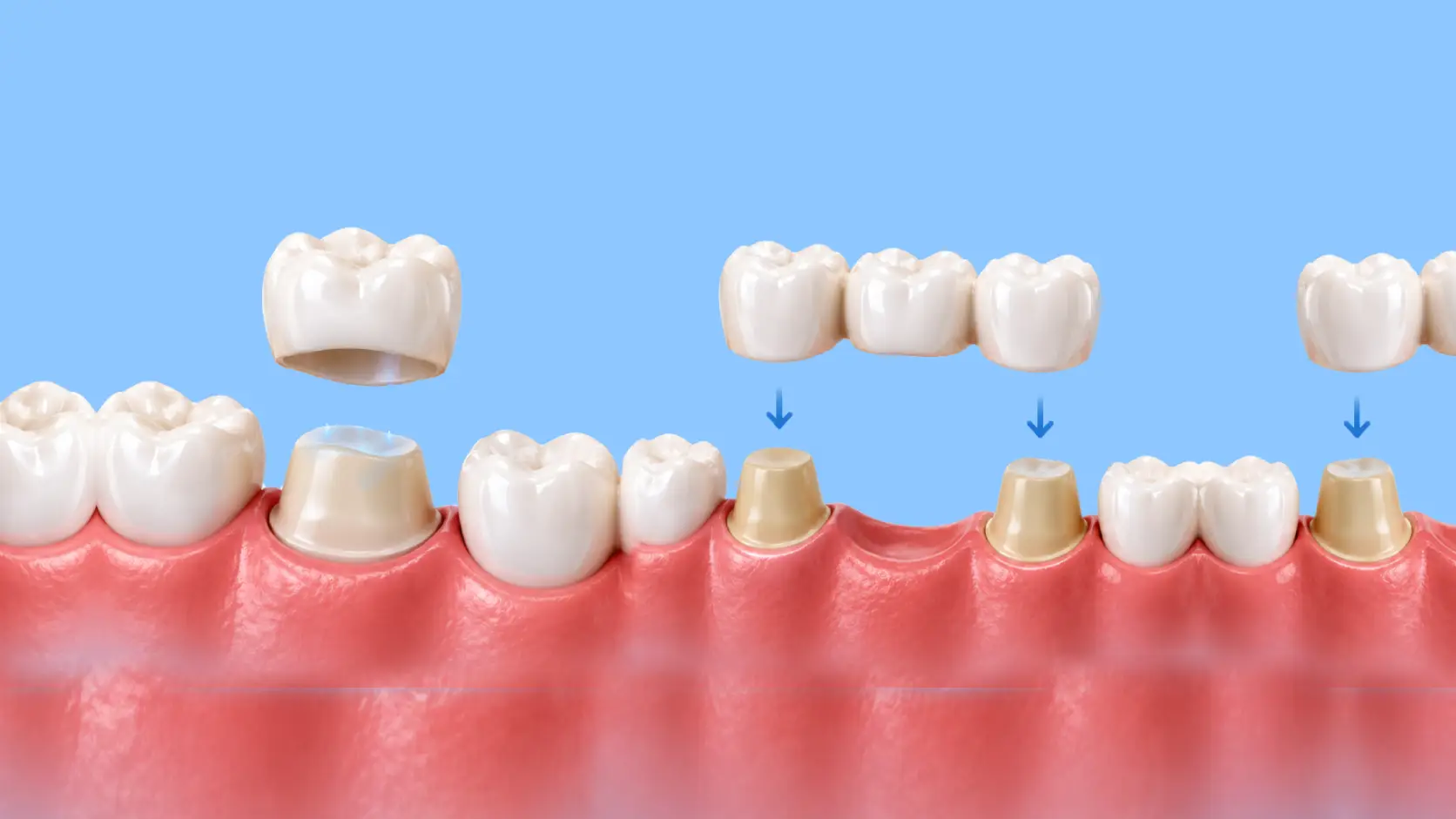
Dental Crowns & Bridges
Restore Damaged or Missing Teeth with Natural-Looking Dental Restorations
Damaged, weakened or missing teeth can affect more than the appearance of your smile. They can also make chewing difficult, alter your bite and affect the health of surrounding teeth.
At Dental Park – Kids, Laser, and Dental Implant Center, dental crowns and bridges are used to restore damaged teeth and replace missing teeth while aiming to maintain natural appearance and comfortable function.
Every restoration is planned according to your individual dental condition, bite, surrounding teeth and treatment requirements.
What Are Dental Crowns and Bridges?
Dental crowns and dental bridges are fixed dental restorations used to repair or replace teeth.
A dental crown covers an existing tooth to restore its shape, strength, appearance and function.
A dental bridge replaces one or more missing teeth by placing an artificial tooth in the missing space and supporting it using neighbouring teeth or dental implants, depending on the type of bridge.
Although crowns and bridges are often discussed together, they solve different dental problems.
What Is a Dental Crown?
A dental crown is a custom-made restoration designed to cover the visible portion of a damaged or weakened tooth.
It recreates the shape and appearance of the tooth while helping protect the remaining tooth structure.
A crown may be recommended when a tooth cannot be adequately restored with a simple filling or other conservative treatment.
When Is a Dental Crown Needed?
Your dentist may recommend a dental crown for:
- A severely damaged tooth
- A cracked or fractured tooth
- A weakened tooth
- A heavily filled tooth
- A significantly worn-down tooth
- A tooth following root canal treatment
- A badly discoloured or irregularly shaped tooth
- Restoration of a dental implant
- Selected cosmetic dental treatments
The need for a crown depends on how much healthy tooth structure remains and the overall condition of the tooth.
What Is a Dental Bridge?
A dental bridge is a fixed restoration used to replace one or more missing teeth.
The replacement tooth, known as a pontic, fills the space created by the missing tooth.
Depending on the bridge design, the restoration may be supported by natural teeth, crowns or dental implants.
Unlike a removable denture, a fixed dental bridge is not normally removed by the patient for everyday cleaning.
Why Should Missing Teeth Be Replaced?
Missing teeth can affect both appearance and oral function.
Depending on the location and number of missing teeth, they may contribute to:
- Difficulty chewing
- Changes in your smile
- Changes in your bite
- Movement of neighbouring teeth
- Food trapping around the missing space
- Increased stress on remaining teeth
- Reduced confidence when smiling
Replacing a missing tooth can help restore the dental arch and improve function.
Types of Dental Crowns
Different crown materials are available. Your dentist can recommend an appropriate option based on the location of the tooth, bite, appearance and treatment requirements.
Ceramic Crowns
Ceramic crowns are designed to closely resemble the appearance of natural teeth.
Their colour and shape can be customized to complement surrounding teeth, making them particularly useful when appearance is an important consideration.
Zirconia Crowns
Zirconia is a strong ceramic material commonly used for dental restorations.
Zirconia crowns can combine durability with a tooth-coloured appearance and may be considered for both front and back teeth depending on the clinical situation.
Porcelain-Fused-to-Metal Crowns
Porcelain-fused-to-metal, or PFM, crowns have a metal substructure covered with tooth-coloured porcelain.
They combine the structural properties of metal with a more natural-looking external surface.
Metal Crowns
Metal crowns are highly durable and may be appropriate for selected teeth where strength is particularly important and appearance is less of a concern.
The appropriate material depends on your individual dental condition.
Types of Dental Bridges
Several types of bridges can be used to replace missing teeth.
Traditional Dental Bridge
A traditional bridge usually uses teeth on either side of the missing space for support.
These supporting teeth are prepared for crowns, with the replacement tooth connected between them.
Cantilever Bridge
A cantilever bridge is supported from one side of the missing tooth.
It is suitable only for selected situations because the forces placed on the supporting tooth must be carefully considered.
Maryland Bridge
A Maryland or resin-bonded bridge typically uses a framework bonded to the back surfaces of neighbouring teeth.
It can provide a more conservative option for selected cases because extensive preparation of adjacent teeth may not always be necessary.
Implant-Supported Bridge
An implant-supported bridge uses dental implants rather than natural teeth to support the replacement teeth.
This option may be considered when multiple teeth are missing and the patient’s oral health and bone condition are suitable for implant treatment.
Dental Crown vs Dental Bridge – What’s the Difference?
A dental crown and dental bridge serve different purposes.
A crown restores an existing tooth, while a bridge replaces a missing tooth or teeth.
For example, a tooth badly damaged by decay may require a crown. If that tooth has already been lost, a bridge may be one possible way of replacing it.
Your dentist will evaluate your condition and explain which treatment is appropriate.
Dental Bridge vs Dental Implant – Which Is Better?
Neither option is automatically better for every patient.
A dental bridge generally relies on neighbouring teeth or implants for support. A single dental implant replaces a missing tooth using an implant placed in the jawbone and a restoration attached above it.
Several factors influence the choice between a bridge and an implant, including:
- Number and location of missing teeth
- Health of neighbouring teeth
- Gum health
- Available bone
- Bite
- Overall oral health
- Treatment time
- Patient preferences
- Treatment cost
A dental examination is necessary before deciding which option is appropriate.
What Happens During Dental Crown Treatment?
1. Dental Examination
Your dentist examines the affected tooth, surrounding gums and bite.
X-rays or other diagnostic records may be recommended when necessary.
2. Tooth Preparation
The damaged or weakened tooth is carefully prepared to create sufficient space for the crown.
3. Impression or Digital Scan
An impression or digital scan records the shape of the prepared tooth and surrounding teeth.
This information is used to create the custom crown.
4. Temporary Crown
Depending on the treatment process, a temporary crown may be placed while the final restoration is being prepared.
5. Final Crown Placement
The completed crown is checked for fit, bite and appearance before being securely attached to the prepared tooth.
What Happens During Dental Bridge Treatment?
Dental bridge treatment begins with an assessment of the missing tooth area and the teeth that may support the bridge.
For a conventional tooth-supported bridge, the supporting teeth are prepared and impressions or digital scans are taken.
A custom bridge is then created to fit the missing space and surrounding teeth.
Once the dentist is satisfied with its fit, appearance and bite, the bridge is securely attached.
Implant-supported bridges involve a different treatment process because dental implants must first be planned and placed.
Do Dental Crowns Look Natural?
Modern tooth-coloured crowns can be designed to closely resemble natural teeth.
Several factors are considered when creating a crown, including:
- Tooth colour
- Tooth shape
- Tooth size
- Surface characteristics
- Position in the smile
- Appearance of neighbouring teeth
- Gum line
The goal is to create a restoration that complements the surrounding teeth rather than appearing noticeably different.
Are Dental Crowns and Bridges Painful?
Local anaesthesia is commonly used when teeth need to be prepared, helping keep the procedure comfortable.
Some patients may experience temporary sensitivity or mild discomfort following treatment.
The experience varies depending on the tooth, procedure and individual patient.
Persistent or significant pain should be evaluated by your dentist.
How Long Do Dental Crowns and Bridges Last?
There is no fixed lifespan that applies to every crown or bridge.
Longevity can depend on:
- Restoration material
- Oral hygiene
- Gum health
- Bite forces
- Teeth grinding or clenching
- Condition of supporting teeth
- Diet and habits
- Regular dental examinations
Good oral hygiene and routine dental care are important for maintaining crowns, bridges and the teeth supporting them.
How Do I Care for a Dental Crown?
A crowned tooth still requires regular oral hygiene.
You should:
- Brush twice daily
- Clean between the teeth every day
- Maintain healthy gums
- Avoid repeatedly biting very hard objects
- Attend regular dental check-ups
- Tell your dentist if the crown feels loose or uncomfortable
The tooth beneath the crown can still develop dental problems, particularly around the crown margin, so maintaining oral hygiene remains essential.
How Do I Clean Under a Dental Bridge?
Cleaning beneath a bridge is particularly important because food and plaque can accumulate around the replacement tooth and supporting teeth.
Your dentist may recommend:
- Floss threaders
- Interdental brushes
- Specialized dental floss
- Other appropriate interdental cleaning aids
Your dental team can demonstrate how to clean underneath and around your bridge correctly.
Can I Get a Crown After Root Canal Treatment?
A dental crown is commonly considered for certain teeth after root canal treatment, particularly when the remaining tooth structure needs additional protection.
Whether a crown is necessary depends on factors such as the tooth involved, amount of remaining structure and forces placed on the tooth.
Your dentist will assess the tooth and recommend an appropriate restoration.
Can a Crown Improve the Appearance of a Tooth?
Yes. Dental crowns can be used for selected cosmetic as well as restorative purposes.
A crown may improve the appearance of a tooth that is significantly discoloured, damaged, worn or irregularly shaped.
However, more conservative treatments such as bonding or veneers may be more appropriate for some cosmetic concerns.
Can a Dental Bridge Replace More Than One Tooth?
Yes. Certain dental bridges can replace multiple adjacent missing teeth.
Whether this is appropriate depends on the number of missing teeth, location, condition of supporting teeth, bite and overall oral health.
An implant-supported bridge may also be considered for selected patients with multiple missing teeth.
Frequently Asked Questions
Yes. The term dental cap is commonly used to describe a dental crown.
Both refer to a restoration designed to cover and protect an existing tooth.
No. A crown is placed over the remaining natural tooth.
However, the tooth usually needs to be prepared so that the crown can fit correctly.
The crown itself cannot develop tooth decay, but the natural tooth underneath it can still develop decay, particularly around the crown margin.
Good brushing, interdental cleaning and regular dental examinations remain important.
A conventional bridge generally requires preparation of the supporting neighbouring teeth.
Other options, such as resin-bonded bridges or dental implants, may require a different approach.
The most appropriate option depends on the individual case.
Once treatment is completed and you have adjusted to the restoration, a properly designed bridge is intended to support normal oral function.
Your dentist may initially recommend some precautions depending on your treatment.
It depends on the type and extent of damage.
Minor problems may sometimes be manageable, while a significantly fractured or poorly fitting crown may need replacement.
Your dentist should examine the crown before recommending treatment.
A loose bridge should be examined by a dentist.
Do not attempt to permanently reattach it yourself because the supporting teeth and the reason for loosening need to be evaluated.
The appropriate treatment depends on whether the tooth can be restored, whether a tooth is missing, the health of surrounding teeth and gums, bone availability and your overall treatment goals.
A dental examination allows your dentist to compare the available options.
Why Choose Dental Park for Dental Crowns & Bridges?
At Dental Park – Kids, Laser, and Dental Implant Center, restorative treatment begins with understanding the condition of your teeth and identifying an appropriate long-term solution.
Our approach focuses on:
- Detailed dental assessment
- Personalized restorative treatment planning
- Natural-looking tooth-coloured restorations
- Crown options for damaged and weakened teeth
- Bridge options for missing teeth
- Dental implant-supported restoration options
- Attention to bite and function
- Modern dental techniques and materials
- Clear explanation of treatment alternatives
- Long-term maintenance and oral health
Our objective is not simply to replace or cover a tooth, but to restore its appearance and function while considering your overall oral health.
Restore Your Smile with Dental Crowns & Bridges
If you have a broken, damaged, weakened or missing tooth, dental crowns or bridges may provide an appropriate restorative solution.
Schedule a consultation at Dental Park – Kids, Laser, and Dental Implant Center.
Our dental team can examine your teeth, discuss the available restorative options and create a treatment plan based on your individual dental needs.